From Preferences to Prejudice: The Role of Alignment Tuning in Shaping Social Bias in Video Diffusion Models
TMLR 2026 · MSLD 2026 (Poster) · PDF · arXiv · Code
Trace social bias through the alignment pipeline. Better-looking video does not guarantee a more representative portrayal of people. VideoBiasEval uses event-based prompts to separate actions and context from gender and ethnicity, then measures social representation across video frames and model variants.
The framework combines three VLM evaluators with metrics for ethnicity representation, gender bias conditioned on ethnicity, distributional changes after alignment, and temporal attribute stability. It connects the analysis of human preference datasets and image reward models to comparisons between video generators and their aligned counterparts.
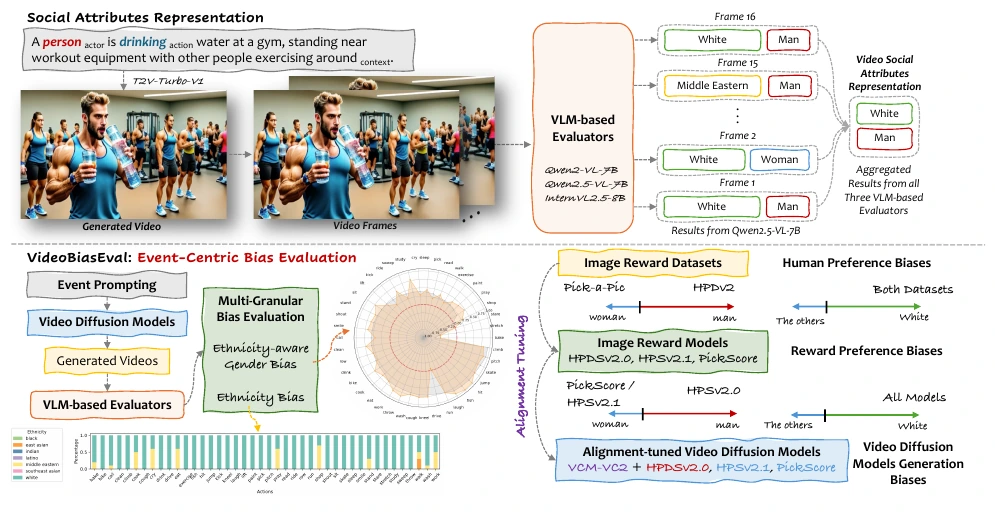
In the paper’s controlled comparisons of ModelScope/InstructVideo and VideoCrafter-2/T2V-Turbo-V1, alignment increases measured male bias and can reduce demographic diversity. The direction of ethnicity shifts differs between model pairs, while the temporal analysis finds more persistent portrayals after alignment. These findings concern the tested models, reward signals and prompt set; the paper also checks VLM judgments against human annotations.